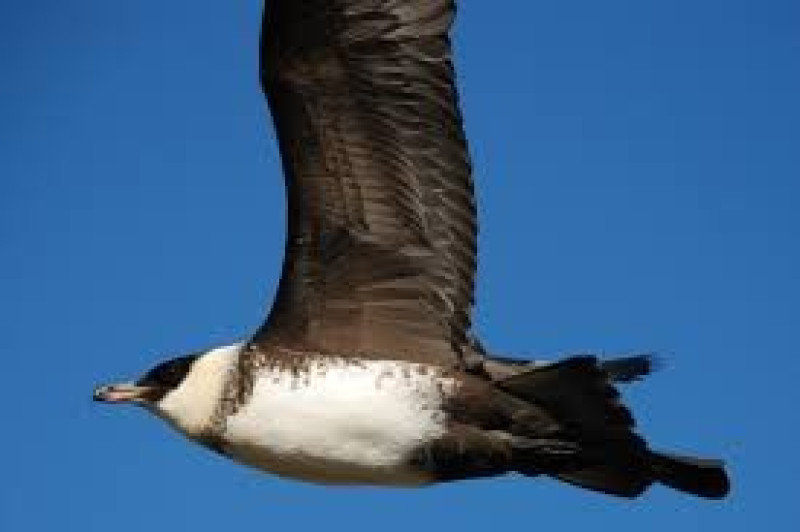
Pomarine Skua
Stercorarius pomarinus
46-51cm
Appearance of the Pomarine Skua
A thicker, bigger bird than Arctic and Long-tailed Skuas. The bill is gull-like, pale with a dark tip, and the tail has streamers coming from its centre, shaped similarly to spoons. Sexes are similar, but there are two colour morphs; the paler is the most common. These birds have barred flanks, whitish underparts, dark caps, white neck and a dark band on the breast. There's a yellow tinge to the cheeks and a pale crescent marking beneath the broad wings. The rarer, all-dark morph resembles the paler bird but it is uniformly dark grey-brown. Juveniles have vivid barring beneath the tail, their legs are pale, and plumage is predominately varied levels of dark grey-brown. They appear all dark when at rest, there are two pale crescent markings beneath the wings and the tail has a blunt end.
Pomarine Skua Habitat
Breeding takes place on the Arctic tundra and resides in offshore waters at other times.
Character
Fundamentally a seabird, unlikely to choose to come to land. This bird is combative, often attacking other birds to steal their prey, or driving them out to sea in the hope of drowning them. When migrating it may be in small groups of less than 20, and occasionally in groups of more than 70.
What does the Pomarine Skua eat?
Fish is this bird's main food when away from breeding grounds, and it also eats other birds and carrion. When breeding diet is mainly lemming and young birds.
Pomarine Skua Breeding
Not a breeding bird of Britain or Ireland. Usually lays 2 eggs in Arctic tundra at the end of June. Adults share incubation and eggs hatch after about 28 days. Young are able to fly at approximately 32 days old.
Population
A passage migrant, this bird leaves its breeding grounds in August, moving southwest over the North Atlantic. Adults are sometimes spotted during May off the south coast of England, the south-west of Ireland, the Hebrides and the Northern Isles. Weather impacts the numbers in the region each year, but most common numbers sit between 50-300.
Observation Tips for the Pomarine Skua
The weather is a major factor in observing these birds; strong winds in specific directions may force birds to the coast. Southeasterly gales in spring may carry birds to the south coast of England, while northwesterly winds may take them to northwest Ireland and the Outer Hebrides. Autumn northeasterly winds make the north Norfolk coast a potential observation site, and southwesterly winds do the same for southwest England and Wales. Alternatively, juveniles can have a habit of dwelling by the coast before continuing their migration.
Voice
Usually a quiet bird when not on breeding territory.