Bearded Tit/Bearded Reedling
Panurus biarmicus
16.5cm
Appearance of the Bearded Tit/Bearded Reedling
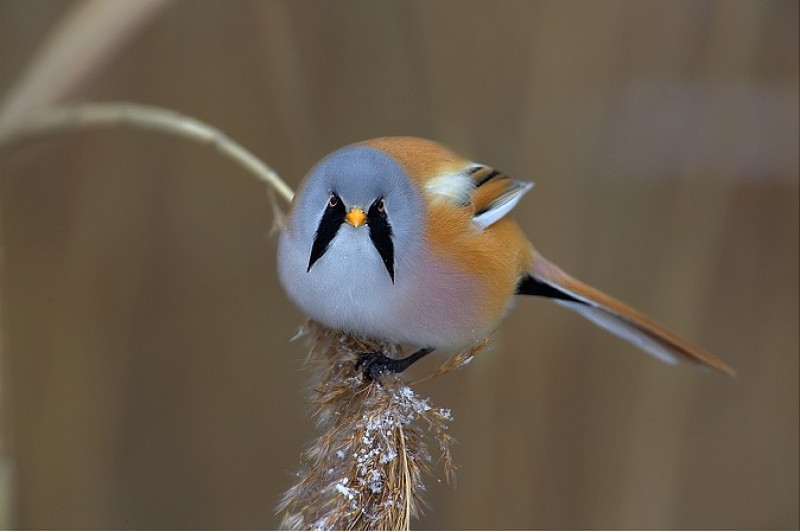
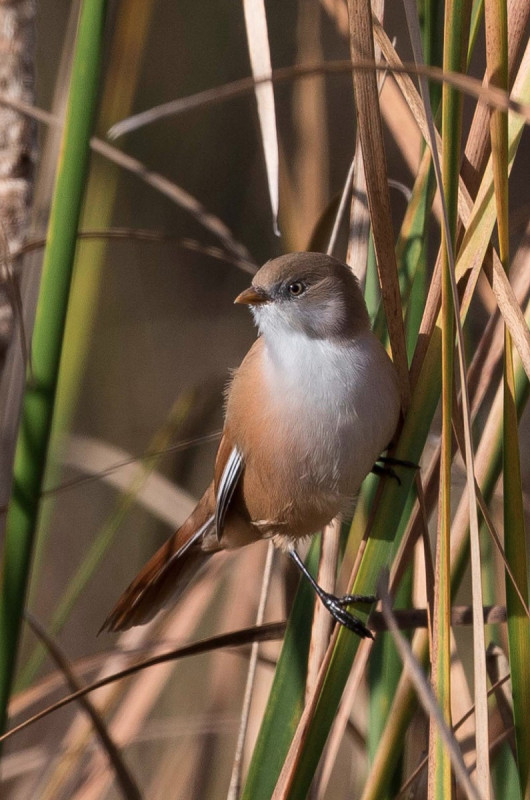
The Bearded Tit is a small, stout bird with a relatively long tail. Males are mostly gingerish-brown overall with bluish-grey heads. They have black moustache-like markings on either side of the throat, black beneath the tail, both black and white marks on the wings, white feathers on the outside of the tail, and a yellow eye and bill. Females resemble males, but they are paler on the throat and don't have the 'moustache' markings, nor the black beneath the tail. Females have darker bill than males. Juveniles resemble female adults but they have blacker backs, whiter throats, shorter tails and the eye is less vivid.
Bearded Tit/Bearded Reedling Habitat
The Bearded Tit primarily lives in thick beds of reeds. It may occasionally relocate to areas of swampy grassland when in a flock.
Character
Is very agile as it manoeuvres through reeds and over the ground. Tail flutters and twitches when flying, and is often seen in flocks, some of which remain together for majority of the year.
What does the Bearded Tit/Bearded Reedling eat?
Summer diet includes beetles, caterpillars, flies, spiders and snails. Winter diet includes the common reed, particularly the seeds.
Bearded Tit/Bearded Reedling Breeding
Birds begin breeding in April; between 4 and 8 eggs are incubated by both the male and the female, a process which takes approximately 10-14 days. Hatchlings depart the nest at about 12-13 days old, but are still dependent for about another two weeks. Two or three broods may be laid during the breeding season.
Population
Most Bearded Tit's remain in one area all year round, but there are exceptions to this such as an occasional surge of movement in autumn, in which Britain may receive birds from the Netherlands. Britain is home to more than 600 breeding pairs.
Observation Tips for the Bearded Tit/Bearded Reedling
This bird can be elusive; its reedbed habitat makes it hard to observe for prolonged periods. The call is best used as a locator for a flock or an individual, and if it is a flock, other birds may be seen moving closely over the reeds, or even perhaps heard. Winter is the optimal time for observation, and areas around Kent, Minsmere and Titchwell are hotspots for the species.
Voice
Has a 'ping' call that gives a sign of this often unseen bird's presence. This call may also be given when flying and when in flocks.