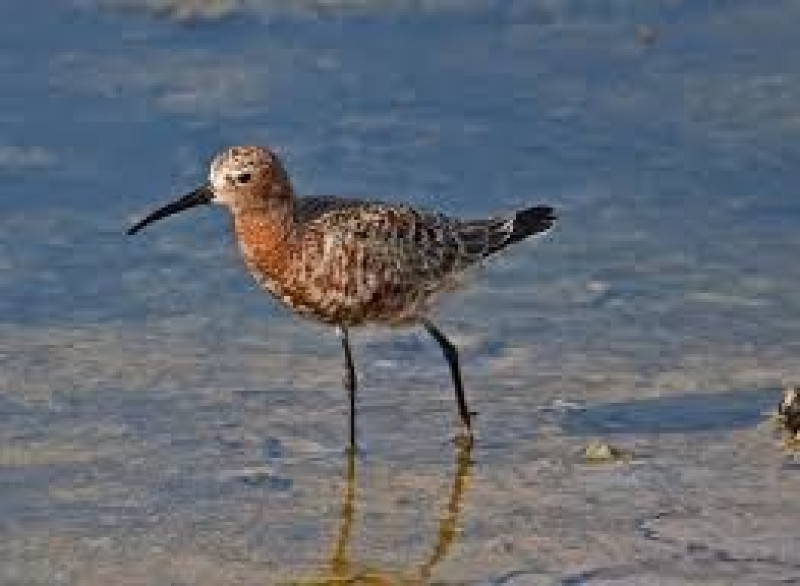
Curlew Sandpiper
Calidris ferruginea
18-19cm
Appearance of the Curlew Sandpiper
This bird is about the same size as the Dunlin, though its neck, black legs and bill are longer; the down-curve of the bill is also marginally more obvious and along with the white rump, is a feature that is consistent at all times. Plumage is otherwise quite variable; in summer, the underparts are reddish-brown, the back is mottled black and white, and for a small amount of time, the face and underparts are reddish-brown, and the female appears more scaly underneath. During winter, a plumage rarely seen in the region, the bird is white underneath and greyish on top, the white more crisp than in a Dunlin; there's a stripe over the eye and the breast has grey streaks. Juveniles appear scaly due to the pale-edged feathers on their back; they have spotted breasts and bellies and a white supercilium. When flying, these birds have narrow white bars on the wings and the distinctive white rump.
Curlew Sandpiper Habitat
When migrating, habitats include saltmarshes, brackish pools, estuaries and the margins of freshwater lakes and pools, usually near the coast. Breeding grounds are the high Arctic's coastal lowlands, near bogs and pools.
Character
May be seen alone or in small groups, often mixing with other waders, particularly the Dunlin. It can appear similar to the Dunlin, but is more likely to stand in shallows when feeding.
What does the Curlew Sandpiper eat?
Eats flies, beetles, shrimps, small marine snails and worms.
Curlew Sandpiper Breeding
This is a scant passage migrant which doesn't breed in the region. Nesting occurs on Arctic slopes, usually facing south, where there is no snow. Both adults incubate eggs, and though young can fly quickly, adults begin migrating before them.
Population
Migrating birds follow three different routes. Birds that arrive in Britain and Ireland are on the edge of the western route; around the European west coast and on to West Africa. Adults hit mostly the east coast of the region from the middle of July to August; juveniles arrive later between mid-August and October and are more dispersed. Numbers can be quite variable, with big influxes seen some years, but approximately 500 – 1000 migrate through Britain yearly, plus 150 through Ireland.
Observation Tips for the Curlew Sandpiper
The males of this species are coloured more vividly than females, though the plumage is so seasonally-varied that separation can be difficult. Autumn sees the most numbers, and of these, most are juveniles. Majority of these are on the coasts of the North Sea, so a trip to one of these areas in late August or early September might give the chance of a sighting; since they often associate with other birds, careful separation from other species may be necessary.
Voice
Has a gentle 'prrrp' which may be uttered in flight.