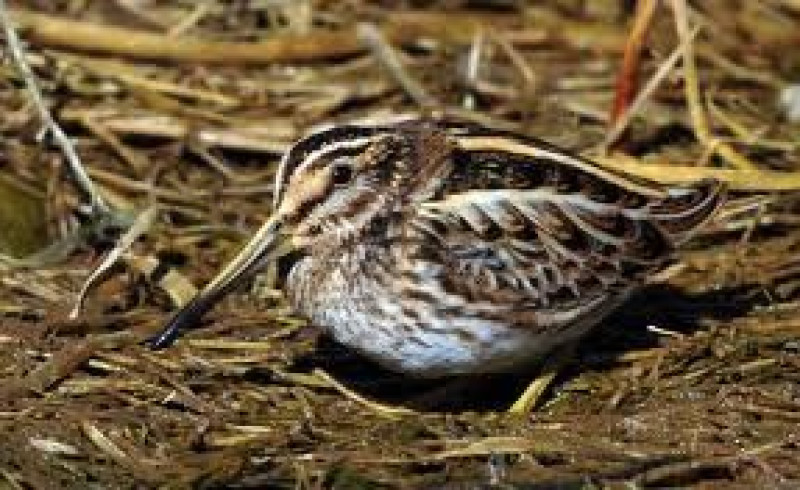
Jack Snipe
Lymnocryptes minimus
17-19cm
Appearance of the Jack Snipe
This is a portly wader, smaller than the Snipe, with a shorter bill and clearer markings on the neck and head. The sexes are similar and juveniles resemble adults. The upperparts are mostly brown, though in the right light there's a green and purple sheen, and there are decorative dark markings on the feathers. There are four distinct, pale brown stripes down the back. The crown is dark with buff stripes, and there's a pale supercilium. The underparts are white and the neck and breast are streaky.
Jack Snipe Habitat
During its winter visits to Britain and Ireland, this bird feeds in muddy margins with thick, low plant-life; habitats include freshwater marshes, reedbeds, old fens, flooded grassland and the banks of rivers and streams. Breeds in the sub-Arctic summer in the open, usually within taiga and birch forests.
Character
This is a notoriously discreet, timid bird that's most active at dawn and dusk. A reluctant flier, this bird prefers to crouch and be stationary until potential danger has gone. It moves with a dipping wobble, like the body is attached to a spring, particularly while feeding or at rest. It's mostly a solitary bird, though may feed close to others in waterside vegetation.
What does the Jack Snipe eat?
Diet includes insects and their larvae, small snails, worms and some plant material, particularly seeds.
Jack Snipe Breeding
Doesn't breed in the region. A cup nest-area is established on the ground, usually on a small ridge near water. Female lays 4 eggs in early May, and she incubates them for approximately 24 days.
Population
A winter visitor to the region, not much is known about the migration of this secretive bird. It's thought that approximately 110 000 individuals spend winter in the UK each year.
Observation Tips for the Jack Snipe
A very difficult bird to locate due to its camouflage and its secretive nature. If spotted, the bobbing motion of the bird is a key identifier; the Scilly Isles are home to perhaps the most promising sites which are best visited in October.
Voice
A quiet bird when not breeding, but it has a variety of calls it uses during display flight such as 'kollarap, kollarap, kollarap', a similar sound to fast-approaching horses.